
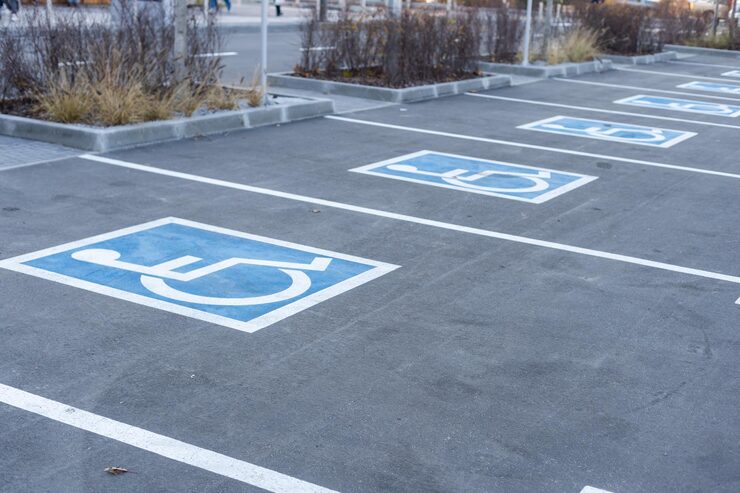
A parking lot can look perfect and still fail an accessibility inspection. The problem often sits in a few hidden inches of pitch. Inspectors place a digital level on the stall, then on the access aisle, and if the reading tops 2%, the space fails. For retail centers, that one number can lead to a costly lawsuit.
At IB Paving, we have spent more than 20 years grading, paving, and striping lots across the Inland Empire. We see these failures every week. In this guide, we explain what the law requires, what inspectors check, and how to find problems early. It is helpful for ADA accessibility for shopping centers, HOAs, and any property with public parking.
What Is ADA Compliance?
The Americans with Disabilities Act (ADA) is a federal civil rights law signed in 1990. It protects people with disabilities from being shut out of public places. Compliance means your property meets the design rules that let everyone arrive, park, and enter safely. That includes people who use wheelchairs, walkers, or canes.
In a parking lot, the rules cover how many accessible spaces you need, how wide they are, and how flat the ground must be. They also cover signs, paint, and the path to your front door. Many owners think a blue sign and a painted wheelchair symbol are enough. They are not. The surface under the paint matters just as much.
Why Is ADA Compliance Important?
A steep stall is more than a paperwork issue. If a space tilts too much, a wheelchair can roll into traffic, and a ramp van cannot lower its lift safely. That is a real safety risk for your shoppers and staff.
It is also a legal risk. ADA compliance penalties at the federal level can top $75,000 for a first violation. In California, the Unruh Civil Rights Act adds at least $4,000 in damages for each visit where a barrier blocks someone, plus attorney fees.
Fixing problems can also pay you back. Owners who qualify can claim a federal tax credit of up to $5,000 per year, which makes ADA compliance for small businesses much easier to afford.
Who Needs to Follow ADA Requirements?
Almost every business that serves the public must follow these rules. The law calls them “public accommodations.” That means ADA compliance for retail stores, grocery chains, gas stations, and strip malls. It also covers ADA requirements for restaurants, from fast-food spots to sit-down dining.
Healthcare sites face stricter numbers. ADA compliance for medical offices often calls for more accessible spaces, since more patients need them. Outpatient clinics need 10% of their parking to be accessible.
Workplaces count too. ADA requirements for offices apply to the lot employees and visitors share. HOAs must follow them for clubhouses, pools, and leasing offices that are open to the public. If people park on your property, these rules most likely apply to you.
What Are the Main ADA Compliance Requirements?
The rules for parking come down to five things: count, size, slope, signs, and route.
- Count: You need the right number of accessible spaces. A lot with 1 to 25 spaces needs one. A lot with 26 to 50 needs two, and the number keeps rising as your lot grows. One in every six accessible spaces must be van accessible.
- Size: Each space needs an access aisle right beside it, at least 5 feet wide.
- Slope: Both the space and the aisle must be nearly flat.
- Signs: Each space needs a mounted sign with the wheelchair symbol.
- Route: A smooth, firm path must link the spaces to the closest accessible entrance.
ADA Compliance Standards and Guidelines
Two sets of rules shape every California lot. The first is the 2010 ADA Standards for Accessible Design. These federal ADA regulations are enforced by the U.S. Department of Justice. They grew out of the ADA accessibility guidelines written by the U.S. Access Board.
The second set is Chapter 11B of the California Building Code. The ADA compliance rules in California are often stricter than federal ones. For example, California requires a tow-away sign at each lot entrance. It also requires the words “NO PARKING” painted in each access aisle in letters at least 12 inches high.
When the two codes differ, you must meet the stricter one. Your contractor should know both codes well.
ADA Requirements for Parking Lots
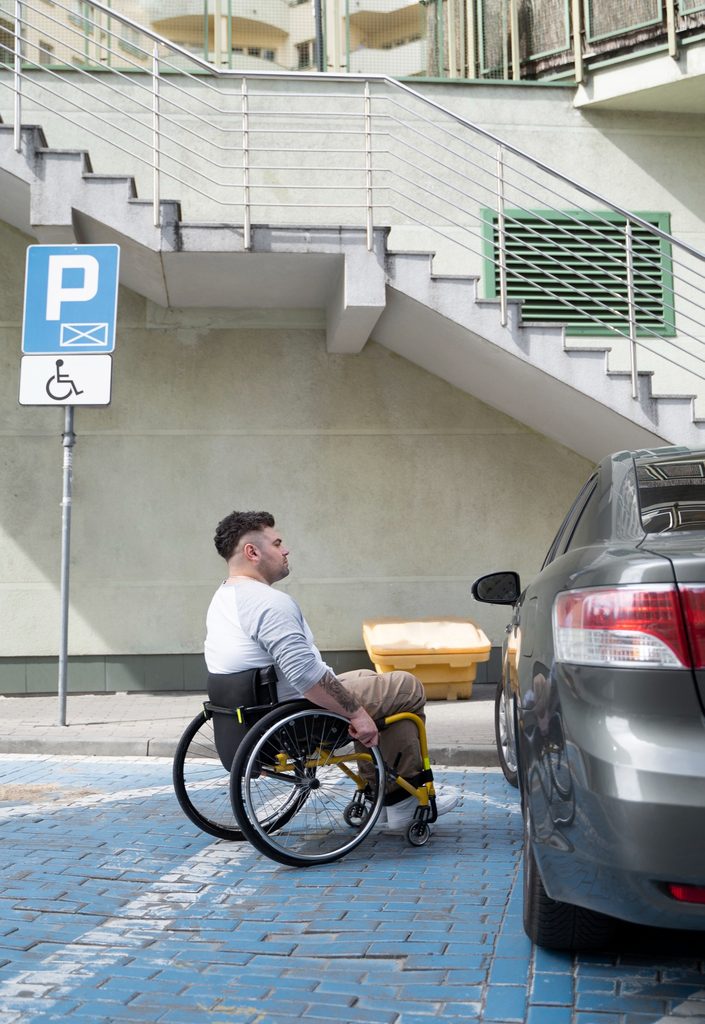
Slope is where most parking lots fail, so it pays to know the exact limits. Accessible spaces and access aisles cannot slope more than 1:48 in any direction. That works out to about 2%, or a quarter inch of rise per foot.
The walking route to the entrance has its own limits. Its running slope cannot pass 5%, and its side-to-side slope must stay at 2%. Any part steeper than 5% counts as a ramp. A ramp can be no steeper than 8.33% and needs handrails if it rises more than 6 inches.
Size matters too. In California, a standard accessible stall is 9 feet wide. A van stall is 12 feet wide with a 5-foot aisle.
| Area | Maximum Slope |
|---|---|
| Accessible stall (any direction) | 2% (1:48) |
| Access aisle (any direction) | 2% (1:48) |
| Accessible route – running slope | 5% |
| Accessible route – cross slope | 2% |
| Ramp | 8.33% (handrails if rise is over 6 inches) |
What Inspectors Measure on ADA Parking Slopes
Inspectors do not guess. Most use a digital smart level and take readings in both directions. They check the stall from front to back and from side to side. Then they do the same in the access aisle.
Next, they walk the route to the door and measure every curb ramp and walkway along the way. They look for bumps, cracks, and small gaps. A change in height of more than 1/4 inch needs a beveled edge, and one over 1/2 inch needs a ramp.
They also tape-measure stall and aisle widths, sign heights, and the clear height for vans. One bad reading anywhere on that route can fail the whole space.
Common ADA Compliance Violations
The same mistakes show up on lot after lot. The biggest one is a stall or aisle that is simply too steep. This often happens when a lot was graded for water to drain, or when old asphalt settles and sinks.
Another common issue is a curb ramp that sticks out into the access aisle. That ramp makes the aisle slope too much. Faded paint is next. If a driver cannot see the stripes, the space does not count.
Inspectors also flag signs mounted too low, a missing van space, and aisles on the wrong side. Cracked or heaved pavement causes problems too. Each of these failures can turn into a lawsuit, so the sooner you find them, the better.
How to Check if Your Business Is ADA Compliant
Start with a simple walk around your lot. Bring a 2-foot level, a tape measure, and your phone for photos. Place the level in each accessible stall and aisle. If the bubble leans past the line, write it down.
Next, count your accessible spaces and compare the total to your lot size. Then check your signs, paint, and the path to your front door. This quick review will catch the obvious problems.
For a full ADA compliance inspection, hire a Certified Access Specialist (CASp). A CASp report lists every barrier and gives you a plan to fix it. In California, it can also give you some legal protection if a claim is ever filed.
ADA Compliance Checklist
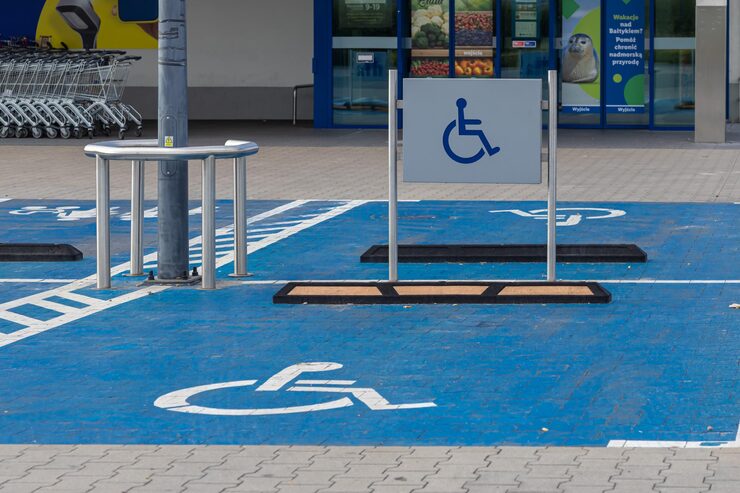
Use this checklist before an inspector or a lawyer finds a problem first. Walk your lot once a year, and again after any repaving, restriping, or major storm. Asphalt moves over time, and a stall that passed five years ago may not pass today.
Keep notes and photos each time you check. Those records show you are taking steps to stay compliant, which helps if a claim is ever filed. If you find a problem, do not just repaint over it. Fresh paint on a steep stall still fails. The fix is to regrade or rebuild the surface so it meets the slope limits. Then restripe it to code.
- Correct number of accessible spaces for your lot size
- At least one van-accessible space for every six accessible spaces
- Stalls and access aisles slope no more than 2% in any direction
- Access aisles at least 5 feet wide, with “NO PARKING” painted in California
- Curb ramps sit outside the access aisle
- Signs mounted at least 60 inches high to the bottom edge
- Tow-away sign posted at each lot entrance (California)
- Accessible route has no running slope over 5% and no cross slope over 2%
- No cracks, potholes, or height changes over 1/4 inch
- Striping bright and easy to see
Fix Your ADA Parking Slopes Before Inspection Day
Most inspection failures start with grading, not paint. Bad ADA parking slopes are hard to see by eye, but easy for an inspector to measure, and they top the list of reasons retail lots fail. The good news is they can be fixed.
IB Paving has served the Inland Empire for over 20 years. We are MBE certified, C-12 licensed, bonded, and insured. Our team handles slope correction, regrading, curb ramps, accessible stall and aisle layout, restriping, and signage. We build to both federal and California codes, so your lot is ready when an inspector shows up.
Request your free online estimate today and let us help you stay compliant.
FAQs
What makes a parking space ADA compliant?
It needs the right size, an access aisle at least 5 feet wide, a slope of 2% or less, a mounted sign, and a clear path to the entrance.
What are the ADA parking requirements in California?
California follows CBC Chapter 11B. It adds tow-away signs, “NO PARKING” in aisles, and 9-foot standard stalls on top of federal rules.
What is the 20% rule for ADA?
When you alter a main area of a building, up to 20% of the project cost must go toward making the path to that area accessible.
What is the most common ADA violation?
Parking problems top the list, especially stalls and access aisles that slope more than 2%, faded striping, and missing or low signs.